

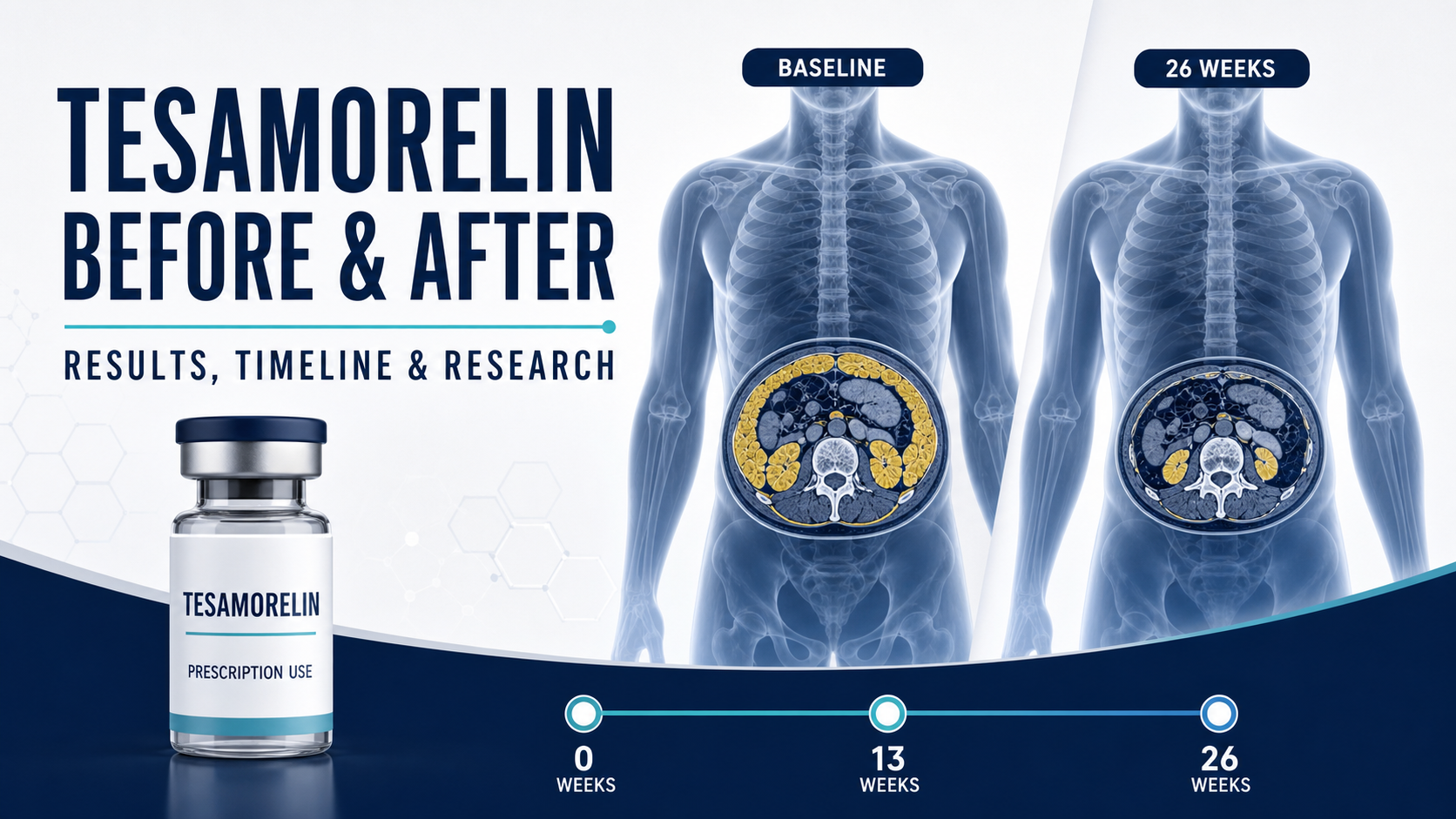
| Medical context: Tesamorelin is a prescription medicine approved to reduce excess abdominal fat in adults with HIV and lipodystrophy. It is not approved for general weight loss, bodybuilding, or cosmetic fat loss. Results and risks should be reviewed with a qualified clinician. |
Quick Answer
In controlled studies of adults with HIV-associated abdominal fat accumulation, tesamorelin reduced visceral adipose tissue over approximately 26 weeks. A pooled analysis of two Phase 3 trials found a treatment effect of about 15.4% for visceral fat compared with placebo. Some participants also had smaller waist measurements and improved ratings of abdominal appearance, but tesamorelin was not associated with the kind of large scale-weight change people often expect from a conventional weight-loss drug.
The most responsible way to read tesamorelin before-and-after results is to focus on CT-measured visceral fat, waist circumference, metabolic monitoring, and the treatment timeline. Changes vary by person, and extension studies found that visceral fat returned after treatment was stopped.
Review the Peptide Stack guide
Tesamorelin Before and After at a Glance
| Measure | What clinical studies found | How to interpret it |
| Visceral abdominal fat | About 15% treatment effect at 26 weeks in pooled Phase 3 data | A CT-measured change around the organs, not a guaranteed visual transformation |
| Waist and trunk fat | Modest improvements were reported in controlled trials | Clothing fit or abdominal profile may change even when scale weight changes little |
| Body weight | Not the primary outcome; major weight loss was not the defining result | Tesamorelin is not approved as a general weight-loss drug |
| After stopping | Visceral fat reaccumulated in extension studies | The effect was treatment-dependent rather than permanent |
What Is Tesamorelin?
Tesamorelin is a synthetic analogue of growth hormone-releasing hormone, often shortened to GHRH. It stimulates the pituitary gland to release growth hormone in a pulsatile manner, which then increases insulin-like growth factor 1, or IGF-1. That mechanism differs from directly administering growth hormone.
In the United States, tesamorelin is approved for reducing excess abdominal fat in adults with HIV who have lipodystrophy. HIV-associated lipodystrophy can involve abnormal fat distribution, including increased visceral fat deep inside the abdomen. This is different from ordinary subcutaneous belly fat, which sits directly under the skin.
The prescribing information specifically notes that tesamorelin is not indicated for weight-loss management. Its weight-neutral effect in clinical trials is one reason a “before and after” comparison should not be reduced to pounds lost.
What Did Clinical Trials Actually Show?
The strongest evidence comes from two multicenter, randomized, placebo-controlled Phase 3 studies in adults receiving antiretroviral therapy who had excess abdominal fat. Investigators assessed visceral adipose tissue using CT imaging at the L4-L5 level rather than relying only on photographs, body weight, or tape measurements.
In the pooled analysis, 806 participants were randomized for the first 26 weeks. Visceral fat decreased by an average of 24 square centimeters in the tesamorelin group while increasing by about 2 square centimeters in the placebo group. The estimated treatment effect was a 15.4% reduction in visceral fat. This is the most useful headline number, but it is an average from a defined study population, not a promise for every patient.
A separate 12-month trial reported an approximately 10.9% reduction in visceral fat after six months compared with 0.6% in the placebo group. Participants continuing treatment reached an approximately 18% reduction at 12 months. Trunk fat, waist circumference, waist-to-hip ratio, and patient-reported distress about belly appearance also improved in that study.
Importantly, abdominal subcutaneous fat did not change significantly. This selective pattern helps explain why some changes may be measurable on a CT scan before they look dramatic in a mirror.
Tesamorelin Results Timeline
Before treatment: establish the right baseline
A meaningful baseline is more than a front-and-side photograph. A clinician may consider medical history, HIV treatment, waist circumference, glucose status, IGF-1, and whether the abdominal fat pattern is consistent with the approved indication. Active malignancy, pregnancy, disruption of the hypothalamic-pituitary axis, and other contraindications must be screened before treatment.
Weeks 1-4: biological changes may precede visible changes
Tesamorelin can raise growth hormone signaling and IGF-1 before a person notices a visible difference. Early weeks are not a reliable time to judge final body-composition results. They are, however, an important period for identifying hypersensitivity, injection-site reactions, fluid retention, joint discomfort, or changes in glucose control.
Weeks 5-12: gradual body-composition changes
By two to three months, some patients may begin to notice a change in waist fit or abdominal profile. Clinical trials were not designed around a universal 12-week visual milestone, so the absence of a dramatic early change does not by itself establish treatment failure. The response should be evaluated through the measures selected with the prescribing clinician.
Weeks 13-26: the clearest trial-based comparison
The 26-week point provides the best-supported before-and-after comparison because it matches the primary evaluation period in the pivotal trials. At this stage, visceral fat, waist measures, side effects, glucose parameters, and IGF-1 can be reviewed together. A photograph may supplement that assessment, but it should not replace objective data.
Months 6-12: maintenance with continued treatment
Extension data suggest that reductions in visceral fat can be maintained or increased when treatment continues. In one study, the decrease was sustained at approximately 18% through 52 weeks. Continued benefit still requires ongoing medical supervision, because exposure also means continued monitoring for adverse effects.
After stopping: results may not persist
The extension studies provide an especially important finding: visceral fat reaccumulated when participants were switched from tesamorelin to placebo. In other words, the measured benefit was not shown to be permanent after discontinuation. Anyone evaluating before-and-after claims should ask whether the “after” image was taken during active treatment and whether follow-up was reported.
What Might Change Visually?
A responder may notice a less prominent abdominal profile, a smaller waist measurement, or clothing fitting differently through the midsection. Those changes can occur without a dramatic drop on the scale because the treatment target is visceral fat rather than total body weight. The exact appearance also depends on baseline body composition, subcutaneous fat, posture, muscle mass, bloating, camera angle, and lighting.
This is why internet transformation photos are weak evidence. They rarely document the approved diagnosis, CT measurements, treatment duration, concurrent diet or exercise changes, medication adherence, or whether the photograph was edited. Clinical measurements are more informative than a highly controlled photo pair.
Who Do These Results Apply To?
The pivotal results primarily apply to adults living with HIV who had lipodystrophy and excess abdominal fat while receiving antiretroviral therapy. They should not be automatically extrapolated to people seeking ordinary weight loss, abdominal definition, anti-aging effects, or bodybuilding results.
Research has explored tesamorelin in other metabolic settings, including liver fat in people with HIV, but research findings outside the approved indication do not establish broad consumer use. A person who does not match the trial population should not assume the same benefits or risk profile.
Factors That Can Influence Results
- Baseline visceral fat: people begin treatment with different amounts and distributions of abdominal fat.
- Adherence and duration: the major trials evaluated consistent treatment over 26 to 52 weeks.
- Individual response: pooled analyses defined responders by a meaningful reduction in visceral fat, and not everyone met that threshold.
- Concurrent health changes: diet, physical activity, HIV therapy, sleep, illness, and other medications can affect body composition.
- Glucose regulation: tesamorelin can cause glucose intolerance or diabetes, making metabolic monitoring important.
- Measurement method: CT-based visceral fat, waist circumference, body weight, and photographs describe different outcomes.
Safety, Monitoring, and Contraindications
Tesamorelin increases IGF-1, and the consequences of prolonged elevation are not fully established. Prescribing information recommends monitoring IGF-1 and considering discontinuation when levels remain persistently elevated. Because the drug can cause glucose intolerance or diabetes, glucose status should be assessed before and during treatment, particularly in people with diabetes risk factors.
Reported adverse effects include injection-site reactions, joint pain, limb pain, muscle pain, peripheral edema, and hypersensitivity reactions. Fluid retention can contribute to swelling, joint discomfort, and carpal tunnel syndrome. People with diabetes should also be monitored for diabetic retinopathy.
Tesamorelin is contraindicated in people with active malignancy, pregnancy, or disruption of the hypothalamic-pituitary axis due to conditions such as pituitary surgery, hypopituitarism, head irradiation, head trauma, or pituitary tumor. A prior malignancy requires careful clinical consideration. This is not a complete substitute for the current prescribing information.
What Tesamorelin Has Not Been Shown to Do
- It has not been established as a general treatment for obesity.
- It does not guarantee a specific number of pounds lost or inches removed.
- It does not selectively erase all abdominal fat, especially subcutaneous fat.
- It has not been shown to produce permanent visceral-fat reduction after treatment ends.
- It should not be evaluated from social-media photos alone.
Frequently Asked Questions
How quickly does tesamorelin work?
Biological effects can begin earlier, but the strongest before-and-after evidence evaluates outcomes at 26 weeks. Visible timing varies, and clinical monitoring should guide interpretation.
How much weight can someone lose?
Tesamorelin is not approved as a weight-loss drug, and scale weight was not the defining benefit in the pivotal studies. The key outcome was reduction in visceral abdominal fat.
Does tesamorelin reduce belly fat?
In adults with HIV-associated lipodystrophy, controlled trials showed a reduction in visceral fat deep inside the abdomen. That does not mean all forms of belly fat respond the same way.
Are tesamorelin results permanent?
No permanent effect was established. In extension studies, visceral fat reaccumulated after participants stopped tesamorelin.
Can before-and-after photos prove it worked?
Photos can document appearance, but they cannot isolate visceral fat or prove causation. Waist measurements, clinical history, laboratory monitoring, and imaging are more reliable.
Is tesamorelin the same as growth hormone?
No. Tesamorelin is a GHRH analogue that stimulates the body’s own pulsatile growth hormone release. It is not recombinant human growth hormone.
Final Takeaway
The most credible tesamorelin before-and-after story is not a dramatic scale-weight claim. It is a clinically measured reduction in visceral abdominal fat over roughly six months among adults with HIV-associated lipodystrophy. Pooled Phase 3 data showed an average treatment effect of about 15%, with some waist and body-image improvements and relatively little emphasis on total weight loss.
Results vary, the approved population is specific, and visceral fat can return after treatment stops. A qualified clinician should confirm whether tesamorelin is appropriate, establish objective baseline measures, and monitor IGF-1, glucose, adverse effects, and the continued need for treatment.
Selected Research
- U.S. Food and Drug Administration. EGRIFTA SV (tesamorelin) prescribing information. 2024.
- Falutz J, et al. Effects of tesamorelin in HIV-infected patients with excess abdominal fat: pooled analysis of two Phase 3 trials. Journal of Clinical Endocrinology & Metabolism. 2010.
- Falutz J, et al. Effects of tesamorelin in HIV-infected patients with abdominal fat accumulation: randomized placebo-controlled trial with safety extension. Journal of Acquired Immune Deficiency Syndromes. 2010.
- Falutz J, et al. Long-term safety and effects of tesamorelin in HIV patients with abdominal fat accumulation. AIDS. 2008.